The rate of autism by country can tell a bigger story than a single number. WHO estimates that about 1 in 127 people globally had autism in 2021, yet many low- and middle-income countries still lack reliable prevalence data. For African families, this creates real challenges: limited data can hide unmet needs, delay planning for services, make awareness harder, and leave parents wondering whether available statistics reflect their communities.
So, which countries report the highest autism rates? Why do figures differ so widely between countries? Does a higher reported rate mean more people have autism, or better identification and diagnosis? What does the available evidence actually tell us about Africa?
This guide explores global autism statistics, explains why country estimates differ, highlights what researchers know about African populations, and helps families, educators, and policymakers interpret the numbers with greater confidence.
Talk to a health specialistWhich Country Has the Highest Rate of Autism?
There is no single global ranking that can definitively identify the country with the highest true autism prevalence. Estimates differ according to the population studied, diagnostic methods, and data year.
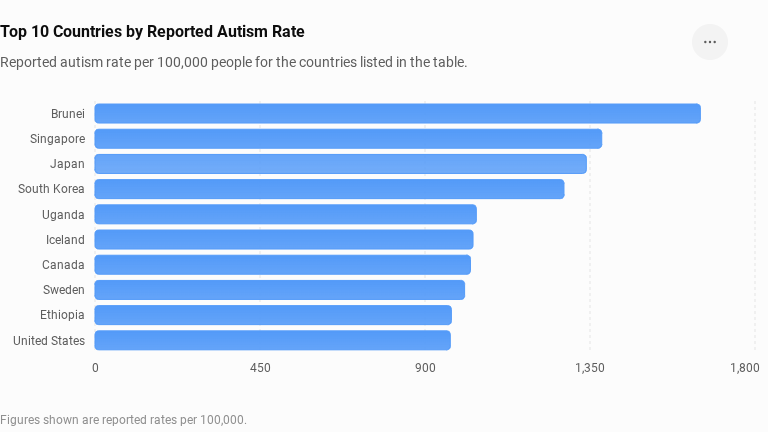
For example, the World Population Review 2026 dataset lists Brunei with the highest reported rate at 1,651 per 100,000 people, followed by Singapore at 1,382, Japan at 1,340, and South Korea at 1,279. The figures represent estimates for 2023, so readers should not compare them directly with older country-specific studies.
Top 10 Countries With the Highest Reported Autism Rates
|
Rank |
Country |
Rate per 100,000 |
|
1 |
Brunei |
1,651 |
|
2 |
Singapore |
1,382 |
|
3 |
Japan |
1,340 |
|
4 |
South Korea |
1,279 |
|
5 |
Uganda |
1,040 |
|
6 |
Iceland |
1,031 |
|
7 |
Canada |
1,024 |
|
8 |
Sweden |
1,008 |
|
9 |
Ethiopia |
972 |
|
10 |
United States |
969 |
These figures describe reported prevalence estimates, not proof that autism occurs more frequently in these countries. WHO notes that global prevalence estimates vary substantially across studies, while prevalence remains unknown in many low- and middle-income countries.
What About Autism Rates Across African Countries?
Available datasets show several African countries among the higher reported estimates, but these figures need careful interpretation. The same World Population Review dataset places Uganda at 1,040 per 100,000, Ethiopia at 972, Nigeria at 820, Ghana at 789, and South Africa at 722.
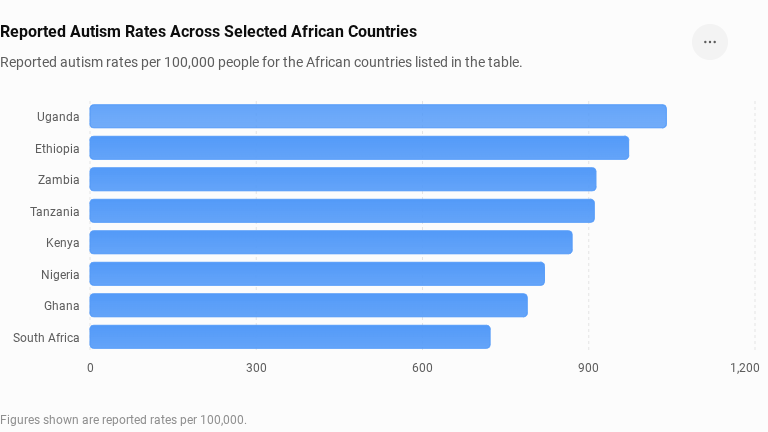
|
Country |
Reported rate per 100,000 |
|
Uganda |
1,040 |
|
Ethiopia |
972 |
|
Nigeria |
820 |
|
Ghana |
789 |
|
South Africa |
722 |
|
Kenya |
870 |
|
Tanzania |
910 |
|
Zambia |
913 |
These numbers should not become a competition between African countries. A 2026 systematic review found major variation across African studies and highlighted limited diagnostic resources, inconsistent methods, and gaps in confirmation services.
For families and communities, Africa Autism Alliance can help turn statistics into greater understanding through autism awareness, education, and inclusion.
Why Do Autism Rates Differ From Country to Country?
The rate of autism by country can change depending on how researchers find and diagnose autistic people. Important factors include:
- Diagnostic criteria: Different studies may use different standards.
- Screening: Stronger screening can identify people who might otherwise remain undiagnosed.
- Healthcare access: A shortage of specialists can reduce confirmed diagnoses.
- Awareness: Greater public and professional awareness can encourage families to seek assessment.
- Culture and stigma: Beliefs about developmental differences can influence whether families seek help.
- Data collection: Some countries maintain stronger population-level records than others.
A 2023 review of autism in Africa identified shortages of specialised professionals, limited resources, gaps in healthcare-provider knowledge and cultural stigma as important barriers to diagnosis and treatment.

Does a Low Autism Rate Mean Fewer Autistic People?
Not necessarily. A low reported rate can reflect limited identification rather than lower underlying prevalence.
WHO estimates that about 1 in 127 people worldwide had autism in 2021, yet many low- and middle-income countries lack reliable prevalence data.
This matters across Africa. A child may grow up without an assessment if their family cannot access a specialist, recognise developmental signs or afford diagnostic services. Research from Nigeria has also identified major gaps in autism research, intervention and social policy.
Therefore, a country's number should answer “how many people have researchers identified?” rather than automatically answering “how common does autism truly occur?” Better screening, culturally appropriate assessment, and stronger health systems can produce more accurate estimates over time.

Why Early Autism Identification Matters
Early autism identification gives children and families more time to understand individual needs and access appropriate support. WHO notes that autism characteristics can appear in early childhood, while diagnosis often happens much later. Timely access to evidence-based support can improve communication, social skills, development, and quality of life.
Early identification can help with:
- Earlier support: Families can explore suitable developmental, communication and educational support sooner.
- Family understanding: Parents and caregivers can better understand a child's strengths, needs and behaviour.
- Educational planning: Schools can consider reasonable adjustments and learning support that match the child's needs.
- Healthcare planning: Health professionals can identify additional healthcare needs and coordinate appropriate referrals.
- Reduced stigma: Accurate information can replace misconceptions with greater understanding and acceptance.
- Better public planning: Reliable identification data helps governments estimate demand for healthcare, education and disability services.
This matters across Africa, where access to autism assessment and specialist services remains uneven. A 2026 systematic review of African studies found a major gap between children identified as high-risk through screening and those receiving confirmed diagnoses, highlighting the need for stronger diagnostic services and primary healthcare training.
Nigeria also has a legal framework that supports inclusion. The Discrimination Against Persons with Disabilities (Prohibition) Act 2018 protects rights relating to education, healthcare and participation, while the National Commission for Persons with Disabilities (NCPWD) serves as the federal regulatory body established under the Act.

How Should You Interpret Global Autism Statistics?
The rate of autism by country needs careful reading. A number from one country may not measure exactly the same thing as a number from another country.
Check these points before comparing figures:
|
What to check |
Why it matters |
|
Year of the estimate |
Older figures may not reflect current evidence. |
|
Age group |
Child, adolescent, and all-age estimates can produce different results. |
|
Sample size |
Larger studies can provide stronger evidence than very small samples. |
|
Diagnostic criteria |
Different definitions and assessment standards can affect results. |
|
Data collection method |
Screening, medical records, and population studies measure different things. |
|
Diagnosed cases or prevalence |
A diagnosis count does not automatically represent the true number of autistic people. |
For African readers, this distinction matters. A country with a lower reported figure may not necessarily have fewer autistic people. Limited assessment and diagnostic capacity can affect how many people researchers identify.
Talk to usFrequently Asked Questions About Autism Rates by Country
What country has the highest rate of autism?
The answer depends on the dataset and methodology. A current World Population Review table lists Brunei at 1,651 per 100,000 for its 2023 estimate, followed by Singapore, Japan and South Korea. These figures should not serve as proof that autism occurs more frequently in those countries.
What country has the lowest reported autism rate?
The same dataset lists Bangladesh at 340 per 100,000, followed by Nepal and Bhutan. A low reported figure does not automatically mean lower underlying prevalence.
What percentage of people worldwide have autism?
WHO's 2021 estimate of 1 in 127 people equals roughly 0.79% of the global population. This figure represents a global average rather than an exact rate for every country.
Which African country has the highest reported autism rate?
The current World Population Review table lists Uganda at 1,040 per 100,000, followed by Ethiopia at 972 and Burundi at 967 in its 2023 figures.
How reliable are global autism statistics?
Their reliability varies. Strong population studies can provide useful estimates, while limited samples or different methods make direct comparisons harder.